


End-to-end insurance transformation powered by AI
Insurance transformation extends far beyond individual use cases. Every AI initiative impacts multiple functions across the insurance organization—from claims and underwriting to finance, operations, and administration. Prime Force partners with insurers throughout this transformation journey, delivering AI-native solutions built into the core of existing insurance ecosystems rather than layered onto legacy technology. Intelligent claims reserving is one example of this approach. As one of the industry's most critical and complex functions, reserving directly impacts financial accuracy, regulatory compliance, and profitability. By combining AI-driven, agentic intelligence with human expertise, Prime Force transforms reserving from a manual, periodic process into a continuous, explainable, and data-driven workflow across Property & Casualty (P&C), Health, Life, and Reinsurance.
From AI Strategy to Successful Deployment
Successful AI transformation begins long before deployment. Prime Force works with insurers to identify the most valuable AI opportunities, prepare enterprise data for AI readiness, and seamlessly integrate AI into existing insurance ecosystems.
Our approach includes:
- Identifying high-impact AI use cases across the insurance value chain
- Preparing and enriching structured and unstructured data
- Integrating AI into existing insurance platforms
- Deploying explainable AI with governance and compliance built in
- Continuously monitoring, optimizing, and expanding AI capabilities
How Our AI-Driven Claims Process Works
Our solution embeds AI directly into the claims lifecycle, transforming raw claim information into structured, explainable intelligence while supporting every stakeholder—from claims adjusters and operations teams to finance, underwriting, and executive leadership.
1. AI Opportunity Assessment & Data Readiness
Before AI is deployed, Prime Force helps insurers identify the highest-value automation opportunities and prepares enterprise data for successful AI adoption. Structured and unstructured content is assessed, enriched, and organized to ensure maximum accuracy, transparency, and business value.
2. Intelligent Data Ingestion
Once a claim is initiated, the process begins with the First Notice of Loss (FNOL). Relevant documents—including policy information, medical records, repair estimates, legal correspondence, expert reports, and supporting evidence—are automatically ingested into the claims management system.
Every claim type follows predefined documentation requirements to ensure completeness and consistency. Documents are preprocessed, classified, indexed, and enriched, enabling AI-driven reasoning throughout the entire claim lifecycle.
Speech-to-text capabilities automatically convert claimant conversations into structured documentation, while AI-powered image analysis can generate preliminary damage assessments from accident photos and other visual evidence.
3. Automated Analysis & Case Intelligence
AI analyzes structured and unstructured information across every claim, extracting key facts, identifying patterns, detecting severity indicators, and comparing each case against historically similar claims.
Rather than simply processing documents, the system builds a comprehensive understanding of the claim, helping adjusters quickly understand its complexity, associated risks, and potential financial exposure.
4. Explainable Reserve Recommendations
Once sufficient information is available, the system generates a transparent reserve recommendation that includes:
- Recommended reserve amount or range
- Confidence score
- Key reasoning behind the recommendation
- Identified risk drivers
- Comparable historical claims
- Complete traceability back to the original source documents
Every recommendation is fully explainable, allowing adjusters to understand not only the outcome but also the reasoning behind it.
5. Human Decision Support & Intelligent Automation
For complex or high-value claims, adjusters remain fully in control by reviewing AI recommendations directly within their existing workflow. They can:
- Accept recommendations
- Adjust reserves based on professional expertise
- Review supporting evidence
- Compare similar historical claims
- Escalate complex cases when necessary
For lower-risk, highly standardized claims, insurers can choose greater automation with human oversight rather than continuous manual review. AI continuously monitors performance, transparency, and compliance, allowing organizations to determine the right balance between automation and human intervention.
6. Continuous Monitoring & Dynamic Reserving
Claims are continuously monitored as new information becomes available. Rather than relying on rigid review cycles, AI automatically updates reserve recommendations whenever new documents, events, or evidence emerge.
The system proactively detects missing information, inconsistent data, litigation milestones, medical developments, and other claim events that require reassessment. Where additional information is required, AI can automatically initiate requests, send notifications, and trigger approval workflows.
This enables insurers to perform portfolio-wide reserve adequacy analysis on demand while significantly reducing manual administrative effort.
Human-in-the-Loop: AI Augmentation, Not Replacement
Prime Force is designed to augment human expertise—not replace it.
AI continuously analyzes information, identifies opportunities, and recommends actions, while human experts retain control wherever business decisions require professional judgment. Where organizations choose higher levels of automation, the platform provides continuous oversight, explainability, and governance to ensure AI remains transparent, compliant, and aligned with business objectives.
Event-Driven Intelligence
Instead of relying solely on scheduled reviews, the solution continuously responds to critical claim events, including:
- First Notice of Loss (FNOL)
- Legal demand letters or attorney involvement
- Medical updates and new diagnoses
- New liability evidence
- Litigation milestones
- Expert assessments and engineering reports
Each event automatically triggers reserve reassessment, ensuring reserves always reflect the latest available information.
Closed-Loop Claims Intelligence
Every processed claim continuously strengthens the platform's intelligence. Historical outcomes, claim developments, and settlement data improve future recommendations while creating a continuous feedback loop across the organization.
Beyond claims management, AI-generated insights are proactively shared with underwriting and actuarial teams, enabling insurers to refine pricing models, improve underwriting guidelines, identify emerging risks, and strengthen future portfolio performance.
Continuous Monitoring Until Closure
Claims remain continuously monitored until final settlement or policy closure. As additional information becomes available, reserve recommendations dynamically evolve, ensuring reserves accurately reflect the current risk position throughout the claim lifecycle.
Core AI Capabilities
The solution combines multiple AI technologies, including:
- Intelligent Document Processing (IDP)
- Predictive Reserve Modeling
- Event-Driven Monitoring
- Comparative Analytics
- Explainable AI (XAI)
- Agentic AI Orchestration
Together, these capabilities create an intelligent, transparent, and scalable reserving process built directly into existing insurance operations.
Advanced Intelligence & Transparency
Transparency is embedded into every recommendation through:
- Explainable AI with clear reasoning and supporting evidence
- Portfolio-wide trend and risk analysis
- Proactive reserve recommendations based on emerging claim developments
- Fraud and anomaly detection
- Continuous feedback to underwriting and actuarial teams for pricing optimization, risk selection, and portfolio improvement
Every recommendation is fully auditable, making AI a trusted decision-support system rather than a black box.
Enterprise Monitoring & Reporting
The platform delivers continuous insights across the insurance portfolio, including:
- Emerging trends and evolving risk patterns
- Portfolio-wide reserve adequacy
- Loss ratio stability
- Automation efficiency and human intervention rates
- Response times to critical claim events
- Claims intelligence supporting underwriting and actuarial decision-making
These insights help insurers continuously optimize operational performance while improving financial planning and strategic decision-making.
Business Impact
Based on our experience, we would expect clients to see improvements such as the following, depending on their existing reserving maturity, processes, and data quality:
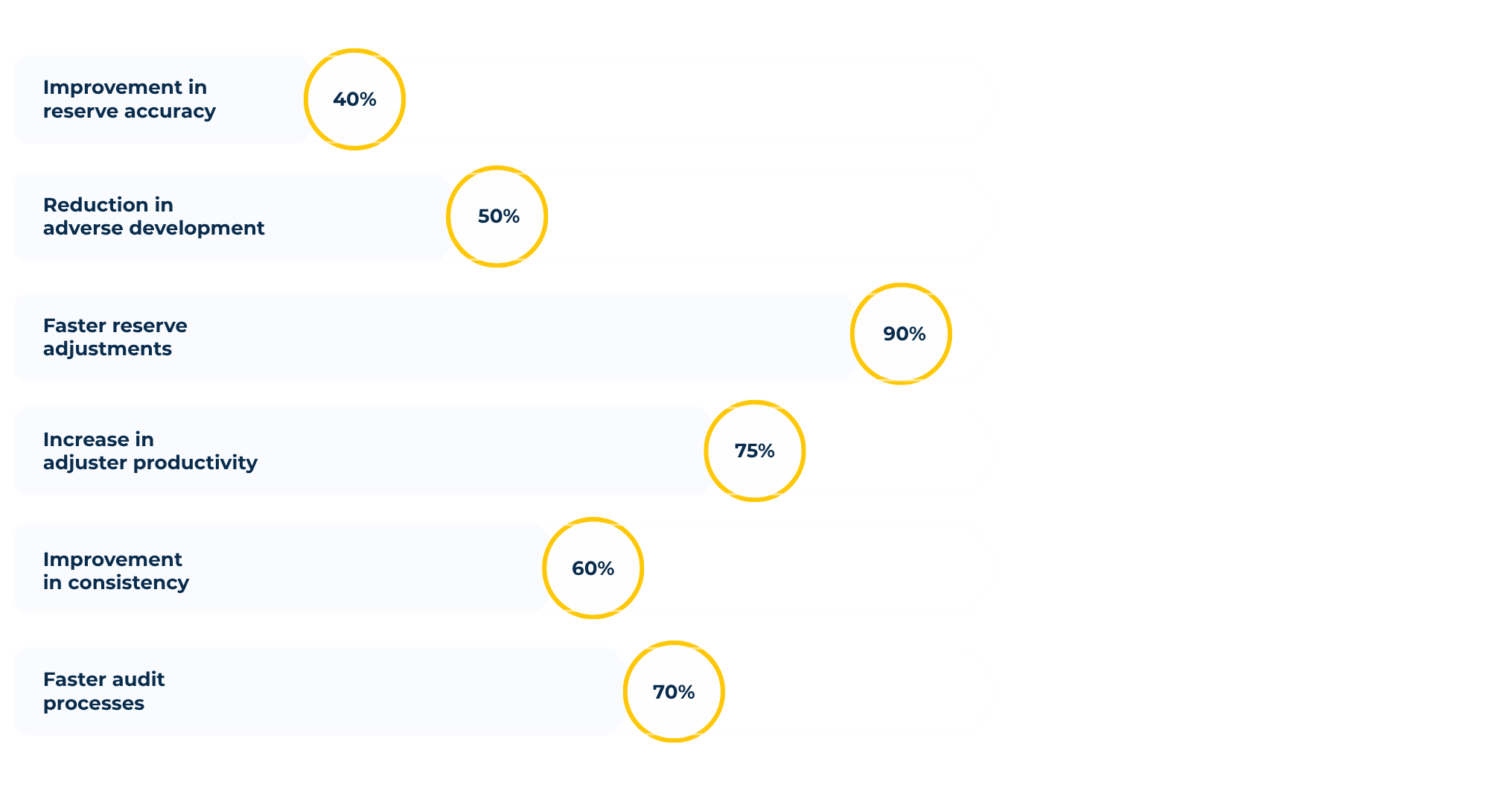
Operational Efficiency
- Reduced manual effort across reserving activities
- Faster reserve updates through continuous AI monitoring
- Greater consistency across adjuster decisions
- Accelerated review and approval workflows
- Improved transparency and auditability
Strategic Benefits
- Improved capital efficiency through more accurate reserving
- Reduced risks associated with both over-reserving and under-reserving
- Greater loss ratio stability supporting forecasting and pricing accuracy
- Better reinsurance coordination through faster, more reliable insights
- Continuous feedback into underwriting and actuarial processes, enabling smarter pricing decisions and stronger portfolio performance
Transform Claims Management with Prime Force
Transform claims management into a continuous, intelligent process powered by AI-driven insights and human expertise. Prime Force enables insurers to improve accuracy, consistency, and transparency across their entire claims portfolio — supporting faster, more confident decisions.